Devlog 013 / Driving
Easy to Drive, Serious at the Limit
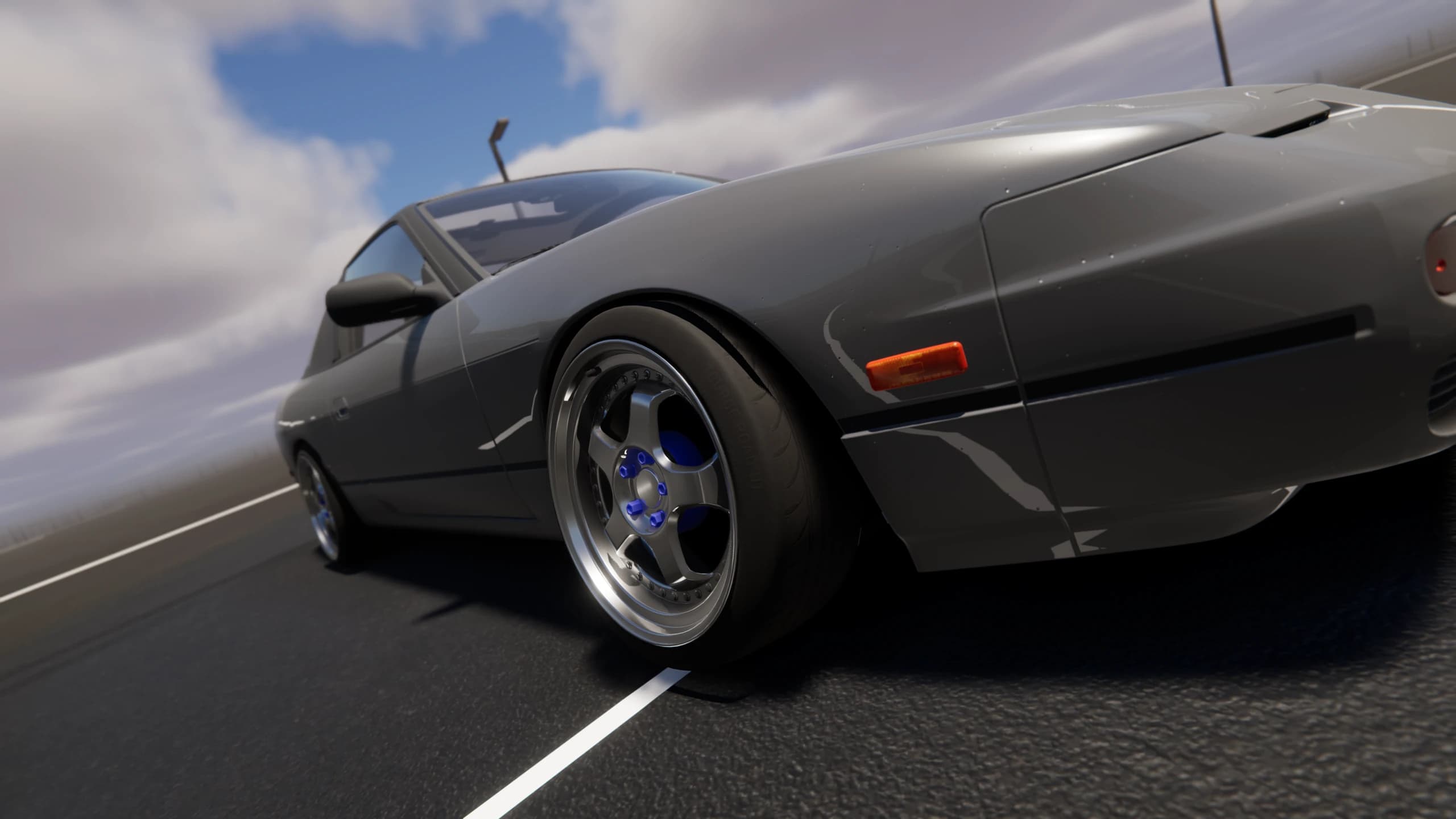
Project Tourge is being built so that driving a normal car normally feels natural. You should be able to pick up a controller, leave the garage and enjoy the road without studying vehicle dynamics first. The car should communicate what it is doing clearly enough that an ordinary drive is fun on its own.
That accessibility does not mean the physics disappear when the speed rises. The game does not turn difficult situations into easy ones just because the player wants to keep the throttle down. A car can be approachable without pretending that every car, setup and speed is safe.
Physics that make sense from the first drive
A stock car begins as a complete package. Its power, brakes, suspension, tyres and factory setup are intended to work together, which makes it the easiest place to learn how the car behaves. Drive within its limits and its responses should feel understandable: weight moves when you brake or turn, the tyres build and lose grip, and the suspension deals with the shape of the road.
You do not need to understand every part of that process to have fun. The physics do the complicated work underneath, and the player feels the result through the car. Smooth inputs produce smooth behaviour, while sudden steering, braking or throttle can unsettle it. That relationship is what makes casual driving possible without making the vehicle itself casual.
The same drift is not the same challenge at every speed
Drifting a stock car at around 30 km/h is entirely possible. There is time to feel the rear move, make a correction and learn how throttle and steering affect the slide. It can be messy, slow and still enjoyable.
Attempting the same thing at 120 km/h in a stock car is a completely different decision. The forces are greater, everything happens faster and the road disappears much more quickly when the angle or line is wrong. Without the right setup and the skill to control it, that is less of a casual drift and more like suicide for the car.
Project Tourge will not secretly turn those two situations into the same easy manoeuvre. More speed should demand more accuracy, preparation and commitment from the player.
Maximum is not automatically better
The tuning screen is not a collection of sliders that should all be pushed to the edge. Maximum caster, for example, is not automatically the correct choice for a 250 hp road car. An extreme setting changes how the steering behaves, how the car responds around centre and how forces build through the rack. It may serve a particular build, but it can also make another car less pleasant or less suitable for what the player is trying to do.
The right setup depends on the car, its power, its tyres, where it is being driven and what the driver expects from it. Tuning should be about creating a combination that works—not chasing the largest number shown by every option.
The road is part of the problem
At ordinary speeds, a small bump is something the suspension can absorb. Hit that same bump at 250 km/h and it may send the car flying. The road has not changed. The amount of speed and energy carried into it has.
Landing is not treated as a harmless animation. The car's weight comes back through the tyres and suspension, the suspension compresses, and the load at each corner depends on how the car meets the ground. A straight, balanced landing is already demanding. Landing at an angle, while steering or with one side touching first can immediately disturb the car. High speed makes ordinary pieces of road matter.
Power is only useful when the car can use it
Installing a powerful engine does not automatically create a fast car. If a build reaches 900 hp, the rest of the vehicle still needs to support it. It needs enough braking performance to slow down, suspension and tyres capable of managing the load, and a tune that gives the driver a chance to put the power onto the road.
Most importantly, 900 hp should feel like 900 hp. Do not expect that car to become calm and controllable simply because the upgrade was expensive. It can spin the tyres, overwhelm a poor setup and punish an impatient throttle input. The player has to learn when the power is available, when the tyres can accept it and when pressing the accelerator harder will only make the car slower.
That is why a properly built and well-driven 600 hp car can be much faster than a 900 hp car. The lower-powered car may brake later, carry more speed through a corner and apply its power earlier because the entire package works together. A number on an engine is potential. The complete car and its driver decide how much of that potential reaches the road.
Casual driving, earned performance
The aim is not to make every trip exhausting. Players who want to cruise, explore and enjoy their cars should be able to do exactly that. A believable car can be easier to understand because it reacts consistently and gives the player something real to learn.
The challenge begins when the player asks more from it. Push harder and the game expects better inputs. Add power and the car expects supporting upgrades. Chase speed and the road begins to demand respect. Project Tourge wants to welcome players into the driver's seat, then leave the depth there for anyone who decides to find the limit.
Easy to drive does not mean impossible to get wrong.
Development archive