Devlog 002 / Physics
Inside the steering rack
August 28, 2026
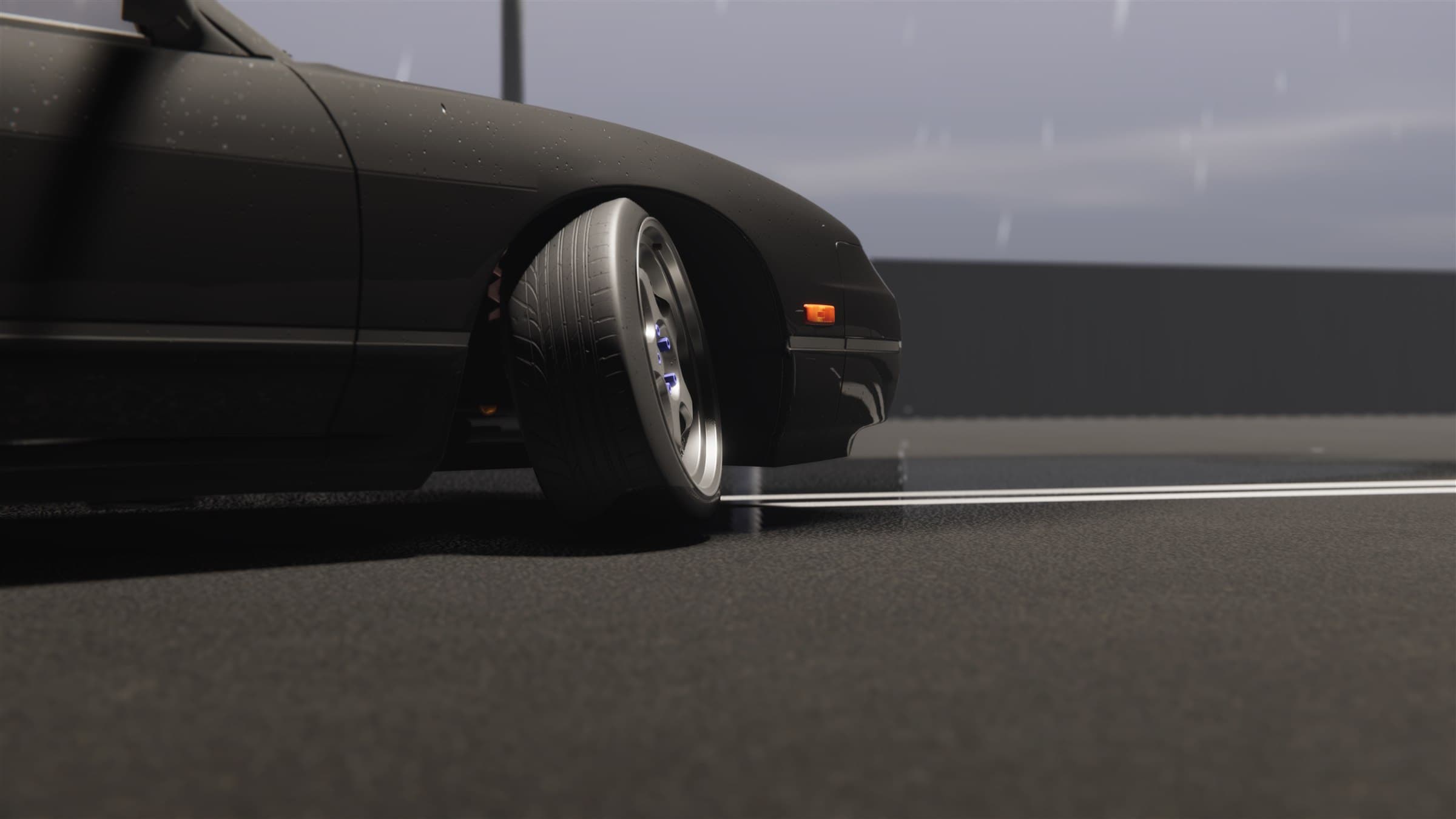
Steering in Project Tourge begins with a rack that can move, accelerate, resist motion and hit its physical limits. The road wheels are not rotated directly from an input value. The driver, the tyres and the steering geometry all act on the same mechanism.
A rack, not an animation
Each vehicle defines its maximum road-wheel angle and rack travel. From there, rack movement is converted into steering angle through the vehicle's geometry. Wheelbase and front track are measured from the car, and Ackermann geometry gives the inside and outside front wheels the different angles they need through a corner.
The rack itself has mass, stiffness, damping, static breakaway friction, moving friction and progressive end stops. Those properties decide how quickly it can change direction and how it settles. Caster, mechanical trail, pneumatic trail and scrub radius turn forces at the front tyres into torque at the steering column.
The result is a two-way system. Driver input moves the rack, but the tyres can move it back. As the front contact patches build lateral force, the steering loads up. As they pass their useful slip range, pneumatic trail reduces and the steering can become lighter. During a slide, the same self-aligning forces naturally pull the rack toward counter-steer.
Making a thumbstick feel connected
A controller has only a few millimetres of stick travel, no steering weight and no physical self-centring force. Giving it a direct, unrestricted path to the car's full mechanical lock would be precise on paper and unpleasant in a player's hands.
For controller and keyboard input, Project Tourge treats the player's command like force applied by hands to the physical rack. Partial stick travel aims for partial rack travel, but the rack still has to move through its inertia, tyre load and friction. Near the requested position, that force eases off instead of snapping the wheels to an angle.
Normal cornering also uses a soft useful-lock envelope. It prevents a small stick from casually throwing the front tyres far beyond the steering they can use, while still allowing genuine understeer. It does not steer the car automatically, and it does not remove the driver's ability to make a mistake. Counter-steer is treated separately: when the car is genuinely rotating in a slide, full rack authority and a faster physical response remain available so the player can catch it.
Other details keep the result readable:
- Small inputs gain authority progressively rather than disappearing into a large dead zone.
- Rack damping settles rapid left-right hunting around centre without filtering away the input.
- Releasing the stick hands steering authority back to tyre self-aligning torque smoothly.
- At a standstill, the rack can hold where it was left instead of unrealistically snapping to centre.
- With the engine off, steering becomes slower to represent the loss of power assistance without reducing available lock.
Different device, same car
A hardware steering wheel does not use the controller layer. Its physical rim angle maps directly to rack travel, with no gamepad response curve, drift catch boost or speed-based lock reduction. The steering rack, front tyres and geometry are unchanged; only the way the driver's hands connect to them is different.
That separation is the balance. A controller receives the shaping required to express a full steering system through a thumbstick. A wheel receives the rack as directly as the hardware allows. Both still drive the same simulated car.
Development archive