Devlog 008 / Vehicle systems
Fuel, tyres and the road between
August 28, 2026
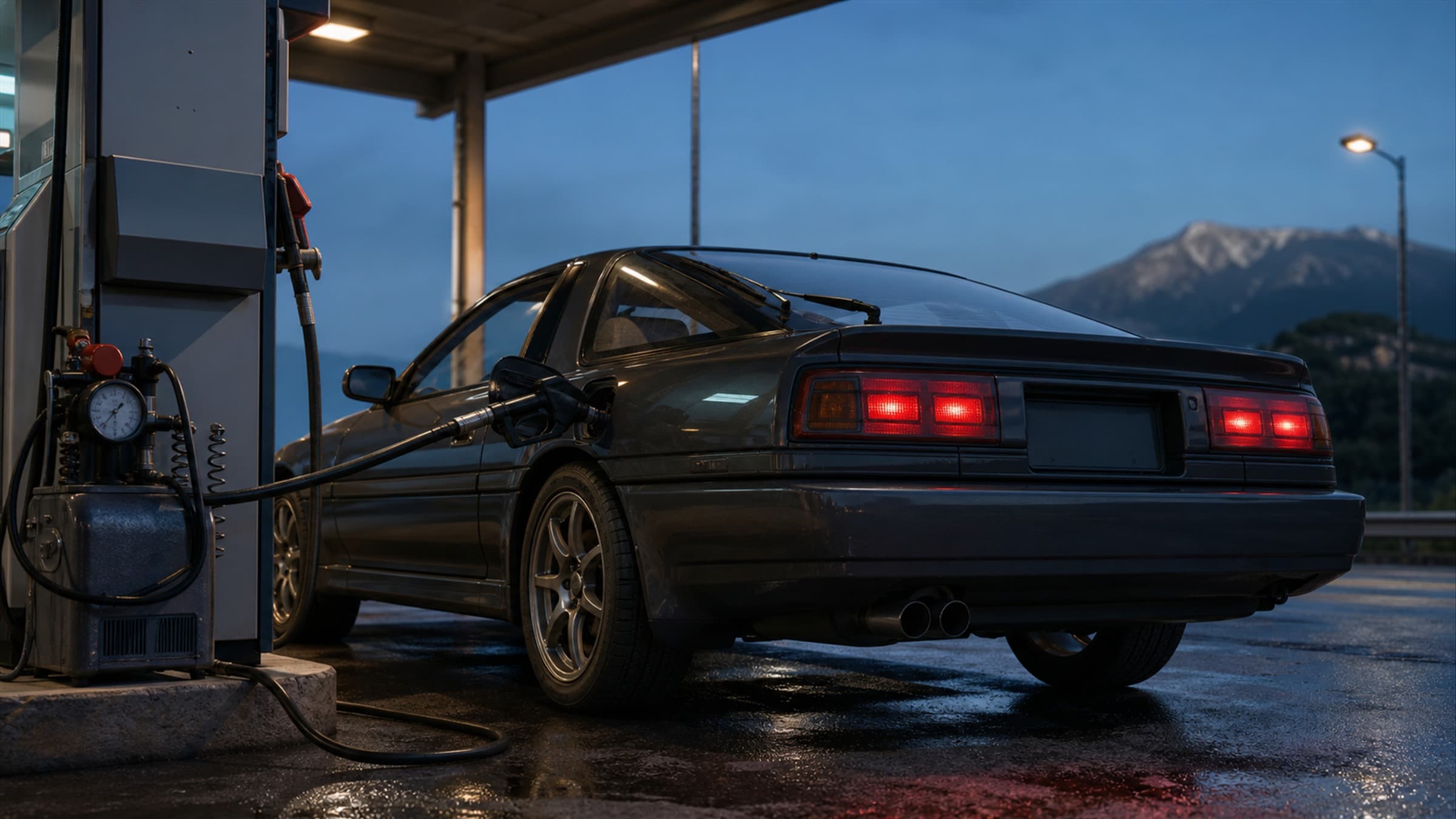
*Generated by AI.
Fuel and tyres are easy to reduce to two gauges: one goes down with distance, the other goes down with wear. Project Tourge treats both as physical parts of the car. The engine consumes fuel according to the work it is doing, the fuel in the tank contributes mass, and each tyre carries its own friction curve, pressure, temperature, durability and visual state.
Fuel follows the engine
Fuel use is calculated from the engine's current brake power, RPM, torque, throttle and load. The system uses brake-specific fuel consumption to convert the work being produced into a fuel-flow rate, then applies the enrichment required under heavier throttle. Idle, light-load running and coast conditions retain their own baseline behavior, so consumption does not become zero simply because the car is not accelerating.
The ECU map is part of that calculation. A richer air-fuel cell consumes more fuel at the matching RPM and load, while a leaner cell uses less and changes the torque result with it. Turbo pressure, engine output and rev range also influence the automatic fuel tune. The number in the tank therefore represents the way the car has actually been driven and configured, not a fixed distance countdown.
Fuel has mass as well. The simulation uses a density of 0.745 kilograms per litre and updates the car's mass as the tank empties or is refilled. A larger fuel tank increases range but does not create free fuel when installed: the number of litres already in the car remains unchanged, and the extra capacity has its own hardware mass.
Near empty, the engine can begin to sputter as fuel delivery becomes intermittent. At zero, the fuel system can no longer support a running engine. Reaching a station is therefore part of looking after the car rather than a purely decorative stop.
The station is a service point
A gas station becomes available once the car is inside its service area, moving at no more than 0.8 km/h and the engine has been switched off. Fuel is purchased by the litre. The player can add a quarter or half of the missing amount, hold the nozzle control, or fill the tank completely; the system only adds what the tank can accept and what the player can afford.
The same location contains the tyre bay. Compounds can be fitted to the front axle, rear axle or all four corners, allowing a staggered setup without forcing every car into one four-tyre package. Front and rear cold-pressure targets can also be adjusted at the station, while the interface displays both the saved target and the heat-adjusted live pressure currently in each axle.
A tyre is a definition, not a grip multiplier
Every tyre definition contains separate longitudinal and lateral Pacejka B-C-D-E curves. B controls stiffness around the initial response, C shapes the curve, D is the peak friction coefficient and E controls the curvature around and beyond that peak. Braking and acceleration therefore do not have to share the exact same shape as cornering.
The current dry peak coefficients show the intended progression:
- Used tyres: 1.05 longitudinal and 1.00 lateral.
- Street tyres: 1.18 longitudinal and 1.15 lateral.
- Sport tyres: 1.38 longitudinal and 1.34 lateral.
- Semi-slicks: 1.58 longitudinal and 1.54 lateral.
- Slicks: 1.78 longitudinal and 1.72 lateral.
Those values are not applied as unlimited grip. Load sensitivity reduces the effective coefficient as vertical load rises, while the four tyre forces still compete inside a combined-slip friction ellipse. Heavy braking leaves less lateral authority for turning; a large drift angle leaves less longitudinal authority for acceleration. Relaxation length also controls how quickly the contact patch builds force, which is why two compounds with a similar peak can still have different response.
Temperature, longevity, rolling resistance and wet sensitivity live in the same definition. Street tyres reach their useful window earlier and retain more durability. Semi-slicks and slicks provide a higher dry ceiling, need more heat and wear more quickly under sustained slip. In rain, the current wet-sensitivity scale moves from 1.0 for the street compound to 2.2 for a semi-slick and 3.5 for a slick, so the dry coefficient alone never tells the full story.
The tyre changes visually with the compound
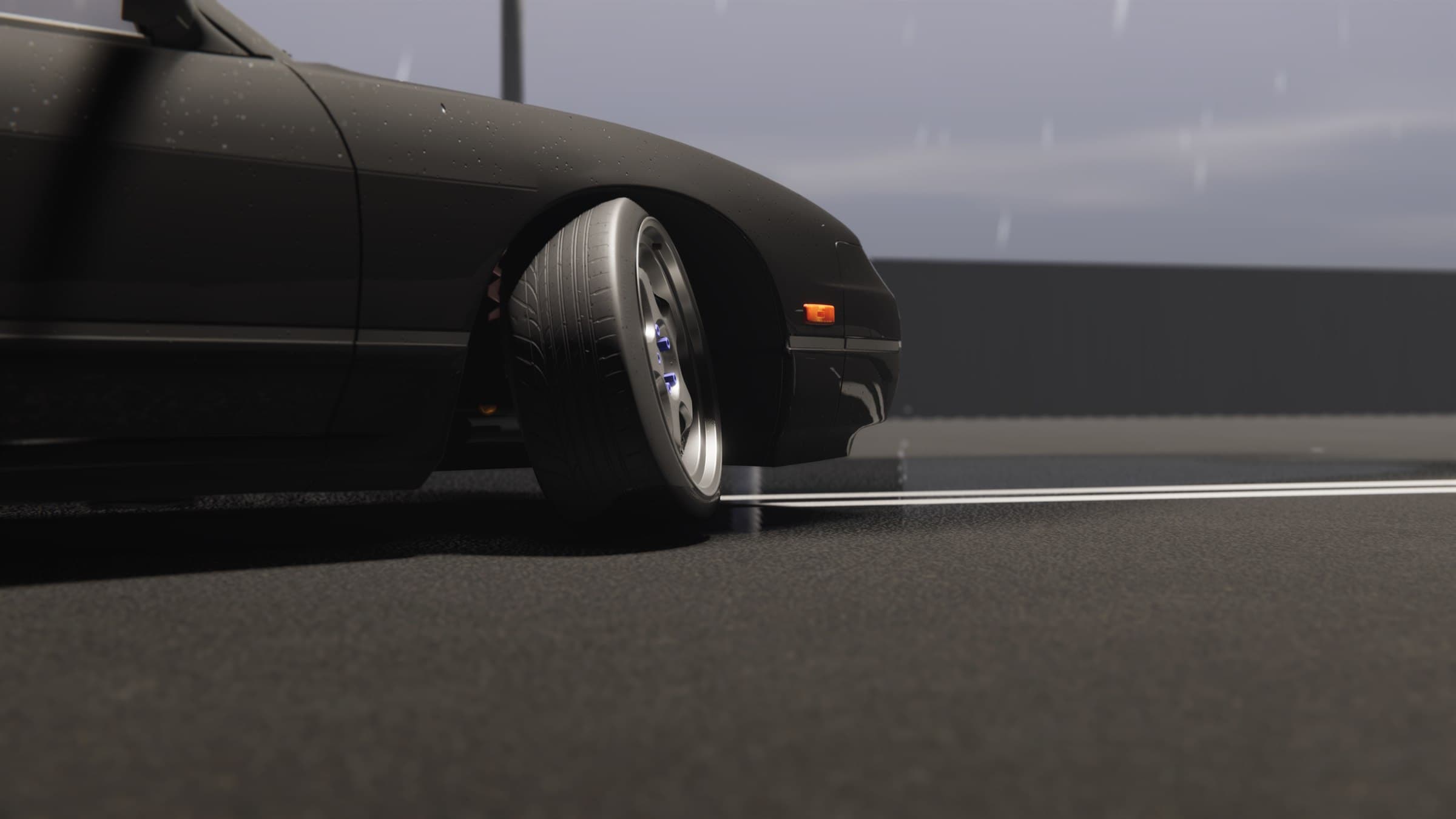
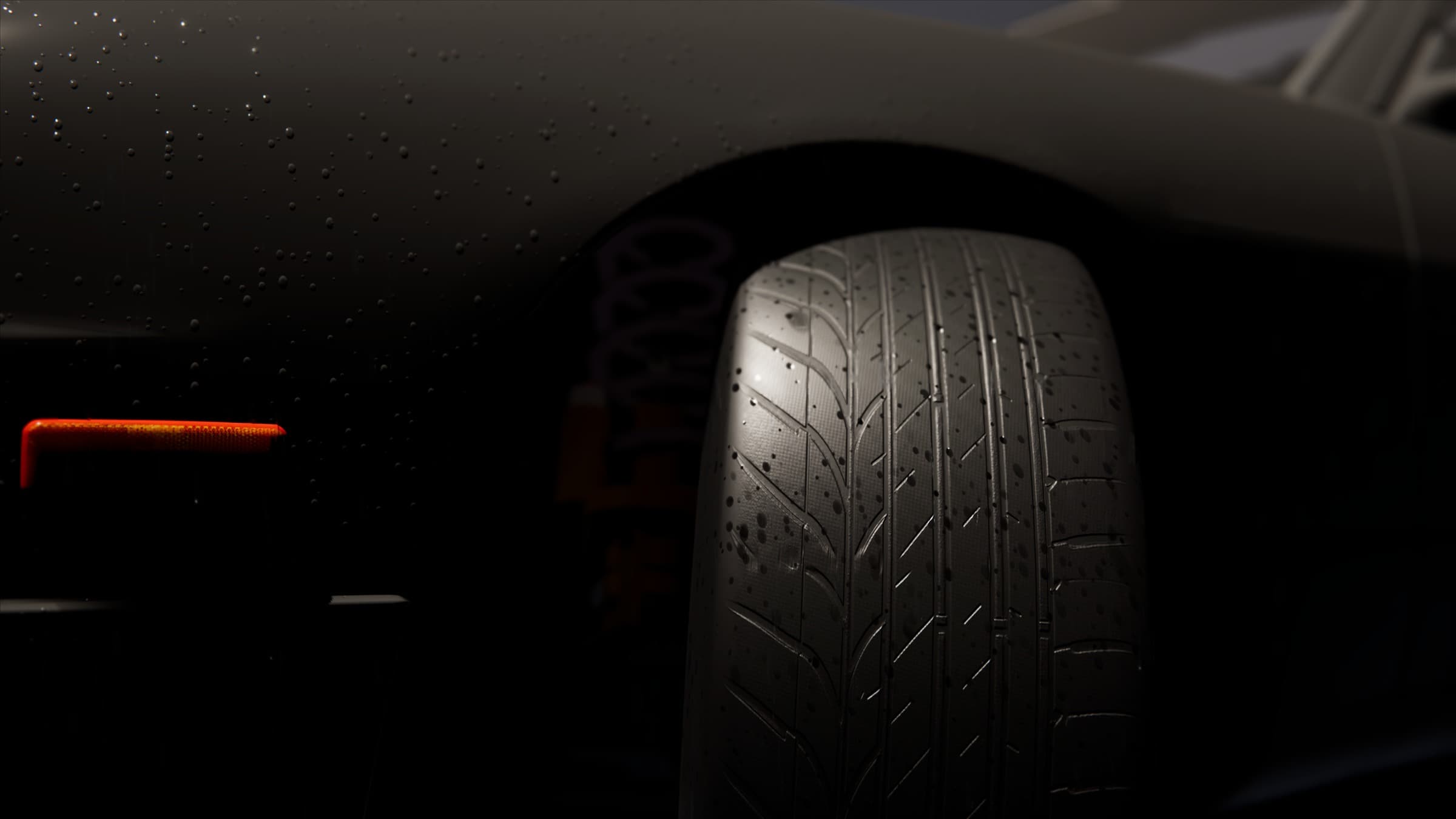
Fitting a new compound replaces more than its numbers. Each tyre supplies its own albedo, normal and HDRP mask maps, allowing tread design, molded rubber detail, surface relief and smoothness to change with the product. The runtime material receives those maps per wheel, so a street tyre, semi-slick and slick do not need to share one generic rubber texture.
Sidewall identity changes with the definition too. Model name, construction marking and rating are authored per compound, while the live size text is rebuilt from the fitted wheel width, profile and rim diameter. Tyre-mark pattern and deposit opacity also belong to the compound, connecting what is fitted to the rubber it leaves on the road.
Wear is visible before failure
Durability is tracked separately for every wheel. Slip ratio and slip angle are normalized against that compound's own load-adjusted peaks, combined as an ellipse and scaled by contact-patch speed and vertical load. That means ordinary parking movement does not consume a tyre, while sustained cornering, braking, wheelspin and drifting do.
The same per-wheel durability value drives a progressive live wear layer in the tyre shader, visibly changing the tyre texture and material as the rubber is consumed. Early wear introduces subtle oxidation and faded lettering. The next stage adds sidewall scuffs and polished tread blocks. Heavier wear produces bald bands, shoulder scrub and small carcass cracks. Near the end of life, sparse belt and cord patches appear through torn rubber. The wear texture changes continuously rather than swapping to one generic damaged tyre at a fixed threshold.
Grip begins to fall only after the compound reaches its configured low-durability threshold. Until then the tyre retains its authored curve; below that point, longitudinal and lateral peak grip are reduced progressively. The physical loss and visible wear therefore come from the same stored state.
Cold pressure and live pressure
The pressure selected by the player is a cold target. Live pressure rises as the carcass heats, up to the range permitted by the fitted definition. Different products begin from different recommendations: the current street tyre starts at 2.30 bar with a 2.60-bar optimum, while the semi-slick begins at 1.85 bar and works toward 2.20 bar. The slick starts lower again at 1.70 bar with a 2.10-bar optimum.
Pressure changes the working tyre rather than acting as a direct grip slider. Vertical load divided by live inflation pressure and tyre width determines contact-patch length. That feeds the relaxation behavior and how quickly force builds. Low pressure increases rolling resistance and heat generation; high pressure shortens the footprint and slightly changes effective rolling radius. The rubber also deforms visibly around the grounded contact patch when pressure is low instead of shrinking the entire wheel uniformly.
This is why the station shows cold target and live pressure separately. A setting that looks low before a run may arrive at its useful value after the tyre heats, while starting too high can push the live pressure beyond the intended window.
When the tyre reaches zero
A fully consumed tyre does not remain a permanently low-grip rubber wheel. At zero durability it blows out: the sidewall collapses, the wheel moves into rim-contact mode, a pressure-release pop and camera response mark the failure, and an exposed rim can scrape, spark and build heat while the car continues to move.
The failed corner remains its own state. One tyre can be gone while the other three survive, changing ride height, available force and the way the car reacts. Fitting a replacement at the tyre bay restores the rubber, resets that compound's durability and repairs the rim-contact state.
Fuel and tyres meet at the same roadside stop because both systems are about continuity. The car remembers how it has been driven, what it is wearing and what remains in the tank. A gas station is where the player reads that history, pays for it and decides what the next part of the drive needs.
The aim is not maintenance for its own sake. It is to make fuel, pressure, compound choice and wear visible in the way the car drives.
Development archive